
Moving Marks: check the oldest mark before a winning move
Each side keeps up to three marks. When that side places its fourth mark, its oldest one disappears before the game checks for a winning line.
Play the gameWorked example
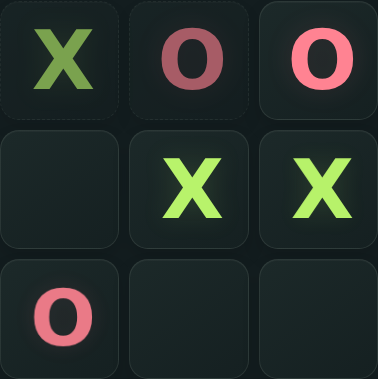
Choose Two Players and Moving Marks. Play X1, O2, X5, O3, X6, O7. X occupies 1, 5 and 6; square 1 is the oldest. X9 looks like it would complete 1–5–9, but placing it removes X1. The remaining X marks are 5, 6 and 9, so there is no diagonal win. Compare the two screenshots.
- 1
- 2
- 3
- 4
- 5
- 6
- 7
- 8
- 9

Try this
- Check which of your marks is shown as the oldest.
- Imagine removing it before judging the next line.
- Choose a currently empty square; the oldest occupied square is not available before the move.
Common mistake
A board that looks similar can have a different result if marks were placed in a different order. Plan with the age of the marks, not only their positions.
Practice
Replay the same position and choose X4 instead of X9. Removing X1 leaves X4, X5 and X6: the middle row wins.